
This complete guide to Florida car seat laws has been updated for 2024. It describes in detail all of the car seat laws in Florida along with Distasio Law Firm’s recommendations to keep kids safe.
You should realize these laws are just the minimum requirements. This guide provides you with the current Florida car seat laws, identifies all of the flaws in the law, and makes safety recommendations. These recommendations will be simple to employ and give your infant, toddler, or young child the best possible chance of surviving a car accident without injury.

This little girl riding in a rear-facing car seat can sit this way as long as the car seat’s manufacturer recommends that it is safe.
Florida Child Restraint Laws: The Official Statute
Florida child car seat laws are governed by section 316.613 Fla. Stat. Below are the basic legal requirements for car seat use:
- Infants and toddlers from birth through age three must be in a separate carrier device or a manufacturer’s integrated child seat.
- Children four years old through five years old to be in a separate carrier device, an integrated child’s safety seat, or a child’s booster seat.
- Children 6 years old and older the option of continuing to use a booster seat or begin using a regular seat belt.
Penalties for not following the law can include a $60.00 fine and three points against your driver’s license. A court can also waive the points and send the person to a child restraint safety program.
Where the Florida Car Seat Laws Statute Falls Short
Unfortunately, other parts of the statute are not very detailed and are not easy for parents to understand. For example, the statute makes it a requirement for all children that are five years old or younger to use a crash-tested, federally approved child restraint system. Unfortunately, it does not define the term “child restraint system.”
Furthermore, the statute only outlines minimum requirements to avoid getting a ticket. These requirements are not the safest thing for your child. If you only follow the minimum requirements of the law, you risk endangering your child in an automobile accident.
For a free legal consultation , call (813) 259 0022
Height and Weight Requirements
Unfortunately, Florida law does not directly address what height and weight you should use for each type of car seat. Instead, the Florida statute only references age limits, but it does indirectly create child weight limits for each type of car seat because the statute requires parents to use a crash-tested, federally approved child restraint system.
The American Academy of Pediatrics and all federally approved car seats base their guidelines on infant, toddler, and child weight and or height instead of age. They do this because every child grows at different rates. Furthermore, age limits create arbitrary cutoffs. Height and weight requirements for each type of child car seat ensure the safest possible outcome in an accident.
When to Use a Rear-Facing Car Seat
Florida law does not specifically address when to use a rear-facing car seat. However, when you follow the manufacturers’ recommendations for the rear-facing car seat you buy, you will automatically be complying with the state of Florida car seat laws for rear-facing children. The following are the basic things you should know:
There is no recommended age to switch your baby from rear-facing to forward-facing. The current national guidelines state that it is safest to keep your baby in a rear-facing car seat for as long as the manufacturer’s guidelines allow. This means your baby will remain rear-facing as a toddler.
It may be legal to switch to a forward-facing car seat once your baby meets this milestone. But the safest thing to do is switch to a larger rear-facing car seat where your child should remain until reaching around 40 to 45 pounds. For some children, this means they will still be in a rear-facing car seat at four years old.
Click to contact us today
When to Use a Forward-Facing Car Seat
There are no specific child car seat laws in Florida regarding facing forward in a car seat. This means Florida car seat laws not only fail to tell parents when to start using a forward-facing car seat, but they also do not tell parents when to stop using a forward-facing car seat. Once again, this means you should follow the manufacturer’s guidelines.
Although some manufacturers suggest switching to a forward-facing car seat at around 25 pounds, the safest thing to do is to wait to begin using a forward-facing car seat until your child is at least 40 to 45 pounds. This means your child may be four years old before you make the switch.
Complete a Free Case Evaluation form now
When to Use a Booster Seat
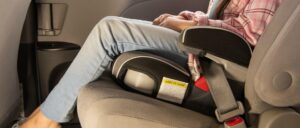
This child sitting in a booster seat can safely continue to do so until they are 80 pounds and 4’9” tall.
Florida law allows a child to start using a booster seat at age four. Most experts believe your child is ready for a booster seat when they outgrow the weight or height limit for their forward-facing car seat. This occurs at weights of up to 85 pounds and a height of at least 35 inches.
Before switching to a booster seat, the safest thing to do is make sure your child meets all of these milestones:
- Your child has outgrown the internal harness of your forward-facing car seat.
- Your child is between 40 and 80 pounds and is at least 35 inches tall but not yet 4’9” tall.
- Your child cannot sit with their back against the vehicle seat with knees bending at the edge of the seat cushion without slouching.
Florida Car Seat Safety Check Locations
Installing a car seat can be complicated. As a result, the overwhelming majority of child car seats are installed improperly. This is why our car accident attorneys recommend that you have a professional perform a car seat safety check to make sure it is properly installed.
There are several ways to make this happen in Florida. You can search this list of Safe Kids inspection stations for a station in your area. At the time of this writing, the Florida highway patrol website also says you can have your car seat installation checked by a certified FHP certified trooper.
When Can a Child Start Using a Seat Belt
Florida seat belt laws allow a child to stop using a booster seat and begin using a seat belt when they turn six years old. For most kids, this is way too young. All safety experts agree that children should be at least 4’9” tall and at least eight years old before they begin using an adult seat belt. In addition to the height and age recommendations, you should also make sure of the following:
- Your child’s entire back is touching the back seat.
- Your child’s knees bend at the edge of the seat and their back is not slouching over.
- The lap portion of the belt crosses as low as possible and touches the thighs
- The shoulder portion of the belt rests across the collarbone between the shoulder and the neck but not touching the neck.
- Your child can sit in this position the entire time in the car.
Most children will be 10 or 11 before they stop using a booster seat. Regardless of Florida’s laws, you should always err on the side of caution and follow your pediatrician and the car seat manufacturer’s recommendations for the safest possible car travel with your child.
If you have questions about your child’s car seat or anything related to a recent car accident call the Distasio Law Firm at our offices in Tampa, Wesley Chapel, or Largo.

GET OUR FREE CAR ACCIDENT CASE GUIDE
Call or text (813) 259 0022 or complete a Free Case Evaluation form